
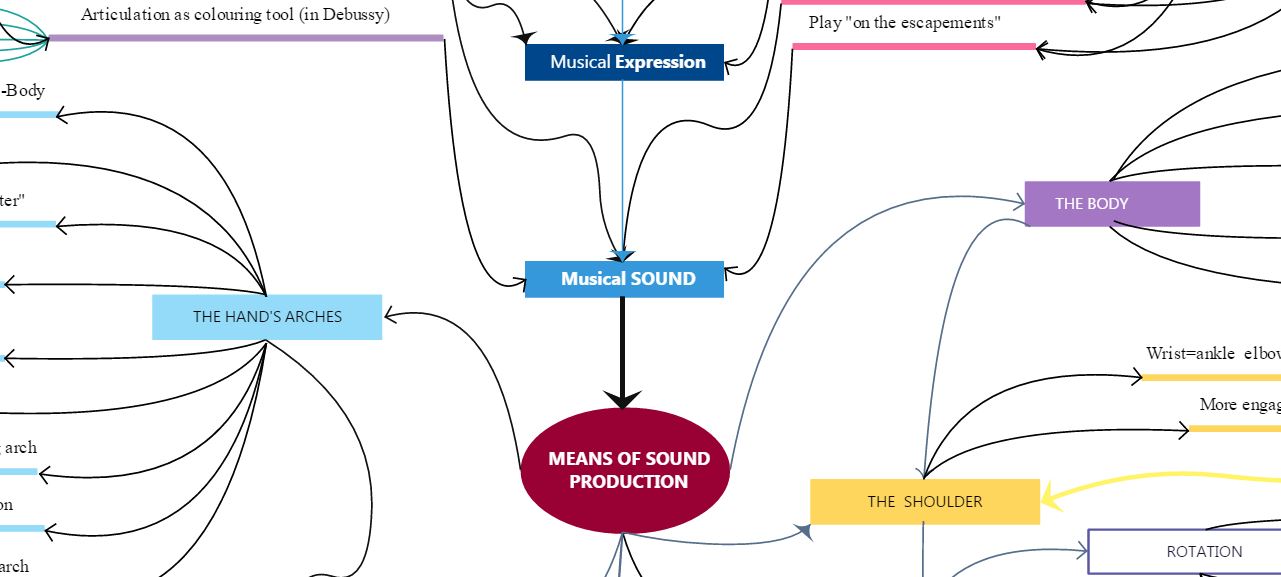
Piano Kinematics Mind Map
Kinematic Integration
American pianist Doug Johnson is fascinated with the phenomenon of movement in music performance. After completeing a training in Body Mapping, he developed his own approach called Kinematic Integration. Alan Fraser has applied these ideas to the piano to create Piano Kinematics, or as it is now known, Piano Somatics - the science and art of pianistic movement.
Piano Kinematics
We've made a Piano Kinematics Mind Map to show how the seemingly complicated structure of Piano Somatics stems organically from a few basic principles. A physical approach to piano technique must arise from the requirements of the music, and must feed back into those requirements, enhancing and expanding the possibilities in pianistic expression. The map illustrates the main foci of Piano Kinematics and their localized branches. Eventually, links to lesson or lecture excerpts will illustrate each thread.
Piano Kinematics Table
If you can't see the chart clearly on your phone, here is a breakdown of the categories:
Root Categories:
Musical Content
...demands...
Musical Expression
... which demands...
Musical SOUND
... which demands...
Specific Means of Sound Production
Branch Categories:
"Make It Speak": Physical/Musical Structural Interface
Rhythmic Structure <-> Hand/Arm Structure
Melodic Sculpting <-> Arm & Hand Function
Hyper-Orchestration <-> Hand Arch Structure
Finger Articulation as a colouring tool in Debussy:
- The Ankle, Knee & Hip Joint
- Needle
- Hammer
- Pad
- Entire Underside
"Make It Speak": Finger/Piano Mechanism Interface
Treat escapement like harpsichord plectrum
Obsessive finger substitution to “tunnel through” keys instead of depressing them
Sense “synovial fluid” under the key
Play “on the escapements”
The Hand’s Arches
The Hand As A Mini-Body
Lay the Hand Down
Grow the Arch Organically – “the monster”
Standing: the Anti-Gravity function
Solid Arch shapes for resonant chords
Walking: Legato generates the arch
Unstable Equilibrium: the moving arch
Integration point for finger & arm function
High Elasticity: full vs. partial arch
The Thumb
Thumb Opposition
Move Thumb Metacarpal
The Arm-Thumb
In Scales & Arpeggios
The Flying Buttress
The Wrist
Function: neutral transmission of forces
Avoid “inverting” wrist and MCP joint
Overactivity indicates weak fingers
The Arm
Triceps stabilizes hand
Principle means of shaping phrase
Possessing mass but not weight
Weighted touch anti-musical and anti-health, can lead to fallen hand arch and performance disability.
Rotation
Eliminates the sense of leaping
Replaces swivelling in scales
Equalizes fingers to smooth out walking
Empowers thumb opposition
The Shoulder
Wrist=ankle... elbow=knee... shoulder=hip joint
Engaged, not over-relaxed
The Body
The Pelvis
The Airport ATM
The 3 Cardinal Directions of Movement
The Sacrum-Sternum Connection
The Collarbone
Performance Disability
Tendonitis
Focal Dystonia
Carpal Tunnel Syndrome
Performance Anxiety
Skeletality
Bones produce tone
Play from inside the key = constant skeletal connection
Elasticity