
Piano Institute Curriculum
The Piano Institute Daily Regimen
- Group Feldenkrais Awareness Through Movement (ATM) lesson
- Seminar-lecture on specific aspects of piano technique
- Piano lesson for each active participant, with all active and passive participants welcome to observe.
Some lessons may be given "behind closed doors" if the participant so desires.
All activities are led by Alan Fraser.
| A SAMPLE PIANO INSTITUTE DAILY SCHEDULE | |
|---|---|
| 8:00-8:45 | Lesson |
| 9-10 | Group ATM |
| 10:00-12:45 | Lessons |
| 12:45-1:15 | Lunch |
| 1:15-2 | Seminar |
| 2-6 | Lessons |
| 6-7 | Evening Meal |
| 7-10 | Remaining Lessons (Optional Private) |
| A SAMPLE PIANO INSTITUTE WEEKLY SCHEDULE | |
|---|---|
| Sunday | Social Hour & Evening Meal 6-7:30 pm Opening Session 7:30-9 pm |
| Monday | Daily Schedule (seminar: New Developments) |
| Tuesday | Daily Schedule (seminar: The Thumb) |
| Wednesday | Daily Schedule (seminar: Arm Weight) |
| Thursday | Daily Schedule (seminar: Rotation) |
| Friday | Daily Schedule (seminar topic: Octaves & Chords) |
| Saturday | Abbreviated Daily Schedule (seminar topic: Musical Aesthetics & Phrasing) Student Recital 8 p.m. (optimal participation) |
| Sunday | Awareness Through Movement 8:30-9:30 am Wrap-up Session 9:30-11:30 pm Farewell & Departure 12 pm |
Alan Fraser Describes His Teaching
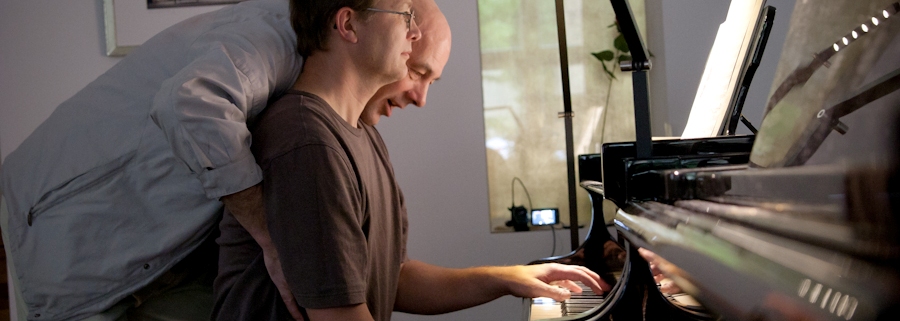
"My teaching is very much 'hands-on.' Your sound improves when your connection to the piano is more organic - in Feldenkrais terms, free from parasitic contraction. Both stiffness and relaxation are superceded by vitality, where you are actively engaged in producing a sculpted, resonant, expressive sonority. You will learn the functional components of this movement style through the lectures, through listening, and through explanation - how to link musical conception to physical organization. At times I explain with a touch that senses and guides without intruding, fluidly joining your hand to the key for a tone both rich and immediate.
'My experience in both piano and Feldenkrais helps my ear and eye ferret out hidden points of tension or weakness that prevent you from creating this sound. Seeing the hand as a mini-body - the fingers as legs, the metacarpal-phalangeal joint as a hip joint, the hand as a pelvis, and the arm as a torso that breathes - helps me pinpoint where your hand fails to stand, walk, run and jump effectively on the keys. Seeing the shoulder as a hip joint helps connect the hand through to the whole body, whose dynamic sitting supports the hand in its empowered relation to the key.
'The physical focus never loses touch with the music. Each physical strategy has an affect on the sound and phrase shape, the musical and emotional expression. Mapping the movement of your physical structure onto the musical structure, you move better while mastering musical content more effectively."